Fiction by Andrew Tesoriero & Mixed Media by Deborah Bell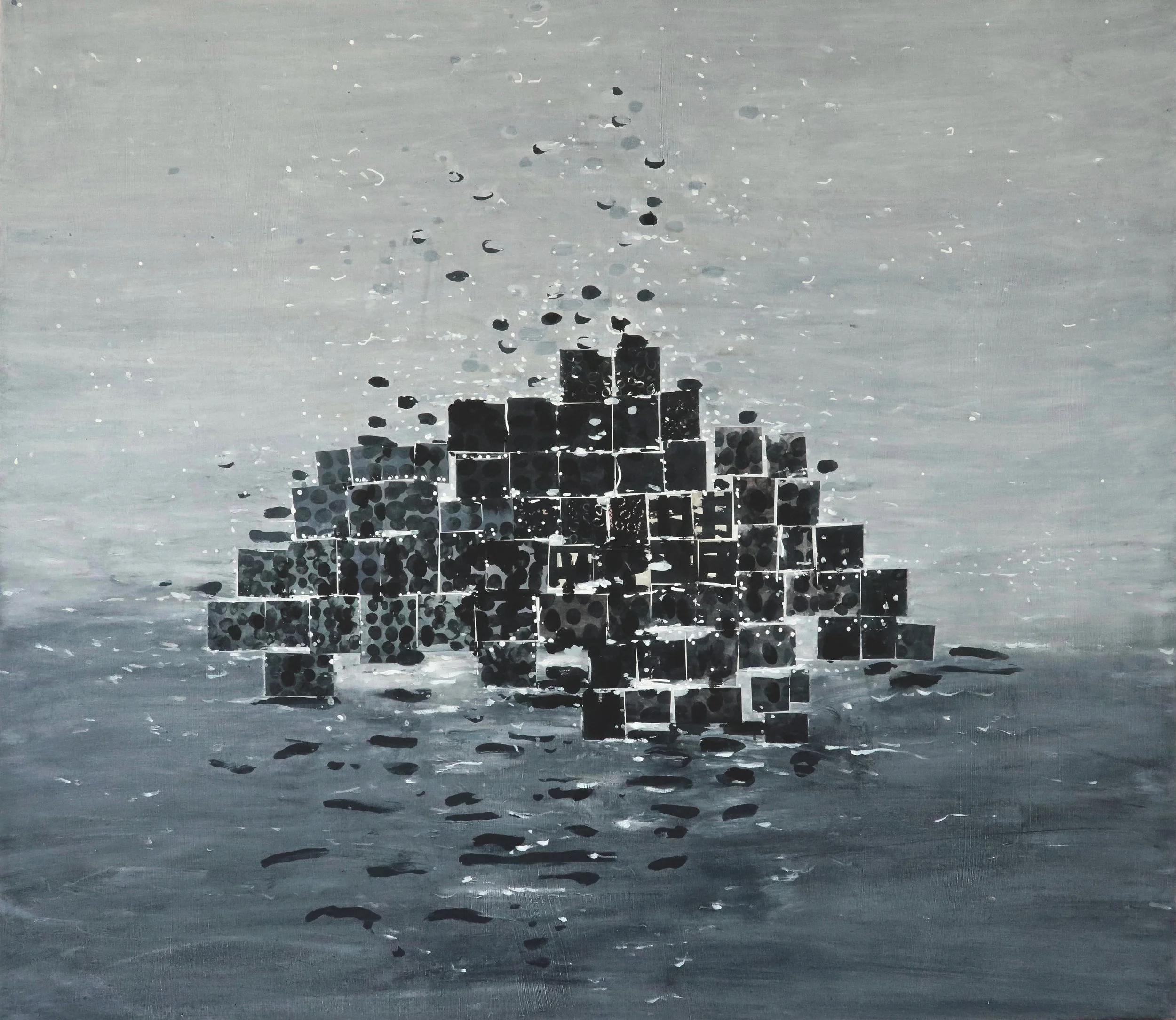
Tidal Island in a Water Body
After the oceans drowned the world, there were seven island cities that rose, though each collapsed before completion; only ours, Palladium, the last, still stands. Our unstable precursors fell into the ocean: half-finished husks of civilization among the coral and kelp; drowned skeletons of skyline now houses for fish, highways for dolphins and whales. Ours: the first to fully stand, the first structure solid enough to beckon skybound humanity back to Earth. Cranes shaped a mountain from dirt on our steel foundation, botanists tilled the earth with seeds to grow wild, our most daring flora turning the dirt to wilderness that could then be tamed. Next came the architects. Our citadel is a garden of visions, our libraries are angular sanctuaries, our skyscrapers are elliptical towers, floors weaving and unweaving like DNA strands. Nodding to history, the architects also built Tudors, manses, castles, ramparts, and parapets—though what would have been a gunman’s crenel is now a sunlit reading nook, someone’s cat perched on the merlon above. For there is no war here.
Then, we came. The poets, the stonecutters, the astronomers, the sculptors, the biologists, the authors, the singers, the guitarists, the drummers, the designers, the physicists, the philosophers, the florists, the playwrights, the chemists, the inventors, the actors, the painters, the archivists, the vanguard of the future filling lantern-lit streets.
We paint on every surface, adorn every road and bridge and wall. Color drips like rain from the eaves. We take dime-sized pills once a year on our emergence day to grant one more year of life. We dance until sunrise, grass between our toes, music thrumming in our ears, bass and drums onward, ever onward, and we breathe the salt-sea air and kiss and hold and fuck each other and break each other’s hearts. We spin through each other’s arms in psychedelic swoons and run through moonlit forest paths with ferns whipping our faces. We build and build upon our Eternal Archive: the history of the fallen world, mourned but not forgotten, and the temple of our world renewed, our endless library of revelatory works: our books, paintings, sculptures, poems, theorems, albums, all our staggering innovations, the infinite creations of our infinite minds. We live to create and to love each other’s creations.
But tonight, I am alone.
My shoes clack on a cobblestone bridge. I’m in one of the higher districts in our designer topography, and the moon sits low in the sky. Here, I could pinch it like a marble between my fingers. I keep walking even though my feet hurt. My phone rings, but I do not answer. It is Matthew or Renee or Elise, calling again. They know by now, but I should have told them. I have no new projects in the pipeline, have announced no new book or play or album or script. My datacube is already a retrospective—see what he made long ago. The midnight bells bring my emergence day, and I have announced no lavish gala to celebrate. They know what this means.
I hold the dime-sized pill in my hand. Like a princess in a fairy tale, I have until midnight to decide. They say it is painless—death. The one thing in our island world without ceremony. Just lie down and fade away.
We have been given the gift of ultimate choice: the ability to conduct our own codas, to decide when and where the last lines of our lives will be written, when ellipsis becomes period. Today, I am two hundred and thirty-eight years old. Buildings swell and spread as I walk, contrapuntal architecture of compression and release. Our city is one giant sculpture, sloped rooftops like rolling hills tumbling end over end. And I have taken every left, every right, every roundabout, every exit. There is no bar I haven’t drank at, no vista I haven’t seen the sunrise from, no dancefloor I haven’t spun circles around, no corner unexplored. I have sixty-eight novels to my name, twelve immersion tunnels, ten short story collections, and thirty-four albums from six different musical projects; I made sculptures out of smoke and conducted strobe light symphonies, designed five neurodecks, and crafted a hundred-and-eight sensoriums; for centuries, I have been working and working and waiting to feel like I have done enough.
Across the bridge, I see the park where I met Matthew, a hundred and twelve years ago. He was walking his dog. A husky, Octavian. I stopped to tie my shoe and Octavian licked my face. Sunlight glittered on the surface of the pond. Matthew apologized, but I laughed and ruffled Octavian’s fur, said I didn’t mind. Matthew smiled, said Octavian doesn’t normally let strangers pet him. Our benefactors did not make dogs and cats immortal, so that we artists would still experience grief. I wept for days when Octavian died. Matthew wrote his most famous symphony then, and I wrote fifteen poems, one for each year of Octavian’s life, even though I was only around for ten of them. The first time Matthew kissed me we were closing out a rooftop bar. I intended to keep my wits about me—since we’d only been out a few times—but lost them in the thrall of easy conversation. He nearly fell over laughing at a story I told about opening night of a play I performed in. My character was a waiter, and I, on my way to the stage, tripped and spilled a prop cocktail all over my costume. The crew started to towel me off but there was no time. I tumbled onto the stage in a mockery of the fall I’d just taken, and the audience laughed so hard I spun it into a gag and kept spilling drinks on myself each time I entered. When Matthew doubled over laughing, he leaned on the balcony railing, and I jumped up to catch him—careful, you’ll pitch yourself over the edge. He stopped laughing with my hands on his shoulders, leaned in, and kissed me.
The moon climbs higher. My phone chimes. Matthew has left me a voicemail. He is crying.
“Don’t do this. You don’t get to do this. I know you have some fucked up complex about originality, about bucking tradition at every turn or whatever but this isn’t your goddamn masterpiece, okay? This is just you hurting the people you love. I love you. Please stay. Please.”
I know if I talk to him, I will stay. I love him, I have always loved him, and I would stay because I love him. But beneath my love for him sits an inexorable exhaustion, a stone in my gut that gets heavier and heavier with each passing day. We were put here to create—and I am empty. Months turned into years and no new ideas have come to me. But the tremor of pain in his voice makes me sick, I swallow my breath. This is a decision I have to make alone. I summit a steep hill, an acute angle from the horizon. My legs burn. My stomach knots. For a moment, I long to be deprived of our world’s greatest gift. I long for some god to smite me, some ancient ailment to claim me, anything, anything to strip me of this dreadful burden of choice. Should I wait around until everyone I love has decided to die? You should never be the last one to leave a party.
I pass the restaurant where Renee agreed to publish my first book, lifetimes ago. She folded the menu, leaned forward with clasped hands—she always had a glimmer in those eyes that said she knew more than you did, which was usually true—and broke the news.
“This is it. This is the one.” We ate at the same restaurant when, halfway through my second book tour, her husband ended their marriage with a voicemail. She cried, lamenting all the warning signs she ignored, all her vanished husband’s selfish habits. We ended up on my porch with bottles of wine. I listened and we drank, and we drank, and fell asleep in the lawn furniture. The next morning, Renee puked over the railing, wiped her mouth, and said she would publish anything I write until the end of time.
“Don’t you goddamn dare. I have a reputation to uphold. If I write a sack of shit, you better tell me it’s a sack of shit.”
She laughed and said, “alright, alright,” and then with an endearing eyeroll: “I hate writers.”
I am in the theater district now. Marquees glimmer and flash: Pentagrams! The punk musical event of the year! in neon cursive on a glimmering billboard. I found it overlong. I keep walking.
Everyone in Palladium is an artist of some renown. We all know each other; we have lived long enough to know each other and only when one decides to die does another emerge from the ships in the sky. When the ship’s hydraulic ramp hisses down, a new artist emerges, adult but naked, an homage to the old ways of natural birth. There are ceremonies. All gather to greet the new artist, to clothe them and feed them. For that day, we are all parent to the newly emerged. That day, we revel as they choose their first craft. Rarely is our first craft the one we make our names in—mine, ironically, was dance, but dance led me to music and writing lyrics led me to prose. Will my replacement be a painter? I have never been a painter. I have no eye for color. The paints I mix always turn brown.
The moon climbs higher, nearing its zenith.
My phone chimes again.
Elise, my longtime musical collaborator, virtuosic on more instruments than I can play, has left me a message. She is not verbose, she never is, but I can hear the strain in her voice.
“Matthew called me. Who’s going to produce my next album if you die? Don’t do it, don’t you dare, you asshole.”
Sometimes, I reread my third novel, The Driftwood Kingdom, and know that it is the best one I will ever write. I wonder, in those lamplit contemplations, if our great gift comes at the expense of our greatest art. Who can live for centuries without becoming cold, detached? Maybe we all do our best work when we are young, just shy of mastery but still hungry for it because we have not yet lost our ability to be surprised by the world, have not yet withdrawn into the complacency that success and security bring. Sometimes, when I visit the Eternal Archive, I envy the rage, the sorrow, the apocalyptic vigor of works from our fallen world. They seem to come from a depth of feeling I’ve never been able to dredge. Is my death a strange gift for Matthew in this way? Shall I be your muse entombed? Write your magnum opus at last, my love, the sonata of my ruin, A Lover Dies in Springtime, because it is always springtime here. If our benefactors had built us an island somewhere dark and cold, perhaps I could write more convincingly about death.
I think that I am a terrible person, I am flirting with the end of eternity only in a desperate bid for attention, a desperate bid to refresh my drained font of inspiration. Empty of ideas, now I will have something new to write and sing about after I pop the pill at 11:59. I will open a blank page in my notebook, I will strum new chords on my guitar, and I will flagellate myself for frightening all the people who love me just to prove to myself that I’m important. I am not important. My death will make someone cry, but that does not make me important.
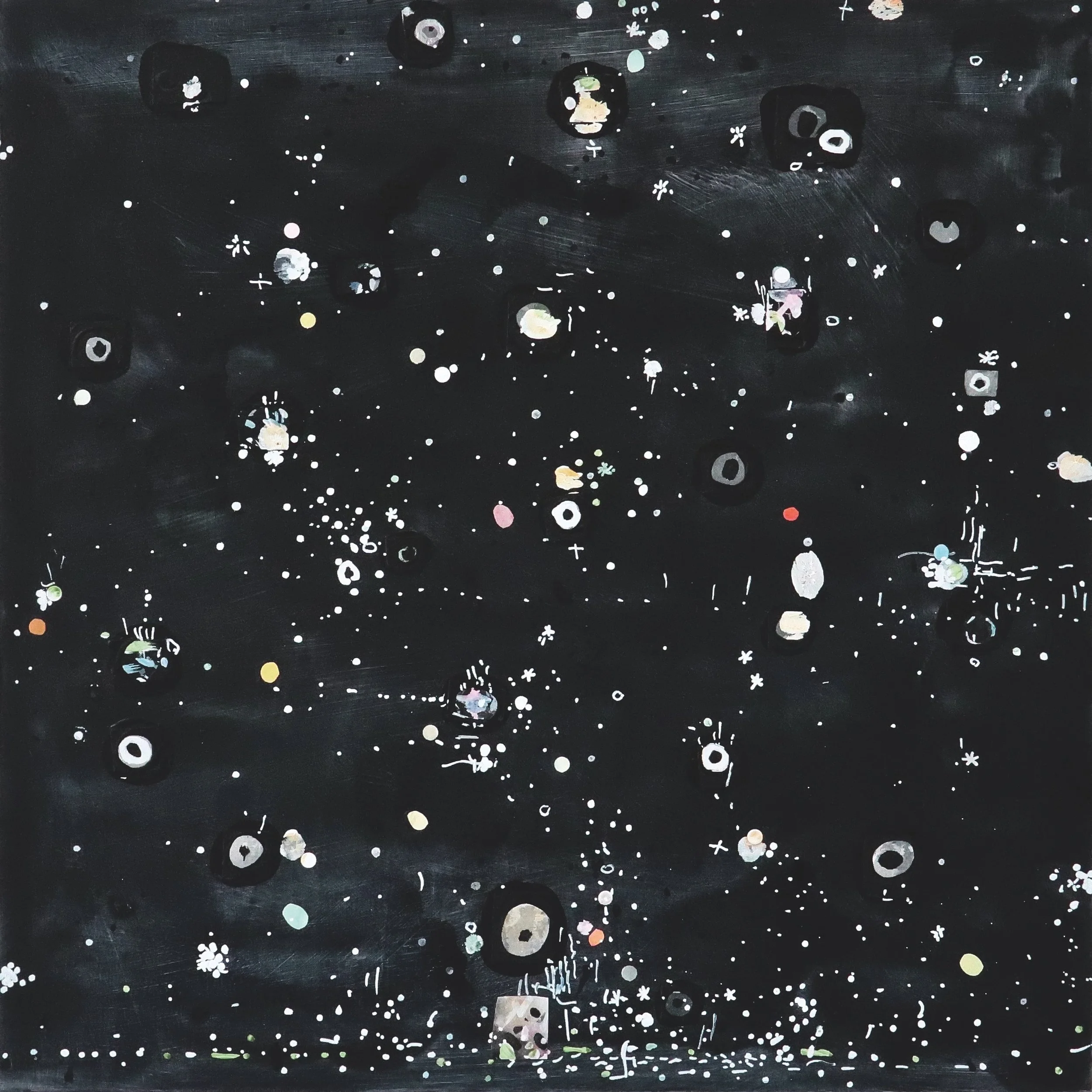
Star Garden
I call Renee. She answers on the third ring, nonchalant.
“Hey.”
“Hey.”
She is silent for a moment, and then: “Well, are you doing it or not?”
“I don’t know.”
Her voice is rueful, warm. “Yeah, you do.”
“Do you think I’m a bad person?”
“Of course not. If I did, I wouldn’t have answered the phone.” She laughs, a wry, percussive sound. “I don’t think someone who loves themselves could have written The Driftwood Kingdom, or made any of those weird snow albums from last century,but that doesn’t mean you’re right to feel that way.” She pauses. “Do you remember what I said when you gave me the first draft of your first manuscript?”
Now, I am rueful. “Whatever you do, do it confidently.”
“That’s it. Have a good night.” She hangs up.
The moon slides higher, higher still. As I leave the theater district, marquees give way to marketplace. Silver walls wind down the avenue, lights scream the names of businesses, and ahead: the floating white sphere of the department store, a spiral escalator snaking down to the ground. If I keep walking, the Market District will turn into a park, and then the pier. I, like all artists, am enamored of the ocean, its infallibility. I want to see it again, but I do not have time, and I couldn’t bear to face the ocean now. Confronted with a dark infinity stretching before me, I would take the dime-sized pill without question.
I wonder what I would turn tonight into, in my fiction, in my songs.
I want to call Matthew. I want to tell him I love him. That I am not doing this to hurt him. But I know that if I hear his voice, if I hear his voice and have no choice but to speak, to witness how my words hurt him as they leave my mouth, I will never be able to say what I want to say.
To say, I love you. I’m sorry that I hurt you.
I reach into my pocket. The dime-sized wafer is still there, chalky against my fingers. My breath begins to quicken. Is it happening? Is this all it is? I thought I would sit on a park bench and wistfully fade but here I am under the department store, the department store of all places. I laugh through ragged breaths, almost gasps, the silent thrill of all the years I’ve borrowed threatening to collapse in on me. Pay the piper, says the humming in my ribs. My hand shakes as I pull the pill from my pocket. Life—brilliant, perilous life—pressed in talc and silica. I open my mouth, raise my hand. I have to decide. Beside me stands a metal sculpture of a melting candle, spilling streetlight amber. In the distance, through the silence, I can hear the ocean. The moon inches up, up, up into the great black eternity of the sky.
Andrew Tesoriero (he/him) writes fiction that entwines themes of war, imperialism, and grief through a speculative lens. He also acts and has appeared as an anarchist newsboy in Portlandia.
andrewtesoriero.comAn artist since she could hold a crayon, Deborah Bell (she/her) is about to enter her eighth decade and still finds magic in the creation process, and in the relational nature of human and artistic community.
deborahbell.org - IG @deborahbell2020